How Canadians feel about sharing information online

Delvinia is a Toronto-based company that helps other companies understand the internet and make it a better place. In order to be useful to their clients they study online culture, and recently they released research into how Canadians use social networking sites and how they feel about sharing their personal information.

Personally, their findings give me a little hope because people seem to understand that blindly sharing their info isn’t a good idea. Still, there is room for improvement as to communicating the reasons why people shouldn’t put all their info online.

Another reason that people should be hesitant to share their lives online is that social networking sites don’t delete photos even if the user thinks that they have.

Delvina’s study can be downloaded here.

SOCIAL NETWORKING
Highlights about Canada’s view towards Social Networking include:

– 83% of female Canadians aged 18-30 feel digital technology allows for easier social connections, compared to their male counterparts at 76%.

– Only 6% of NGen and 4% of Gen X report visiting recent media darling, Twitter, in the last month. The same as other, less talked about social networks including Hi5, DIGG and Tagged.

– There is a significant difference between how frequently Canadians visit social network sites vs. post content. YouTube experiences the greatest difference between views and posts – for example, while 83% of NGen visited YouTube only 6% posted content. While 59% of Boomers visited the site, only 4% posted content.
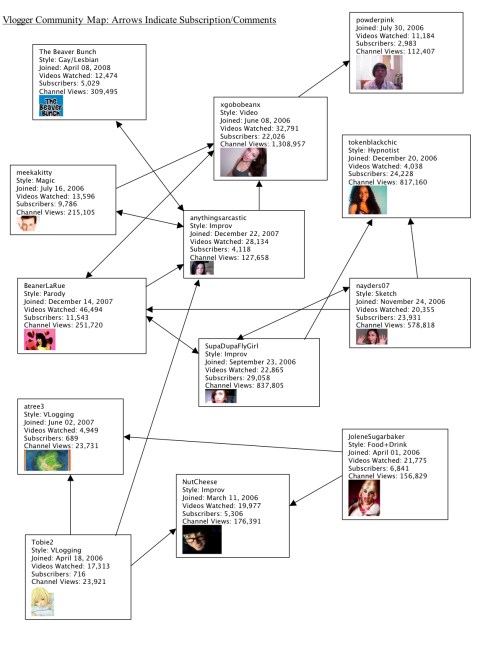
New Research: Videoblogging

Women Videobloggers and YouTube: Participatory Informal Digital Learning and Open-Access Web-Based Research
This research project engages female videobloggers (vloggers) to develop three aspects of internet studies presently unexplored in existing literature.

(1) Unique web-based methodology: First, we are developing an innovative and experimental web-based methodology: rather than conducting the traditional “confidential” interviews, we interview female videobloggers within the very medium they themselves have chosen for public, creative, and political expression: YouTube. We will develop interview questions in a You Tube video post (filmed and posted by Kelly Ladd, under the supervision of the Dr. Megan Boler) and the female videobloggers will respond through their own YouTube channels and videopost responses. Thus the research conversation will be (a) immediately transparent and open to the public; (b) “answers” will remain under the participants’ “ownership,” thereby creating a new model of open access and transparency of research process too often hidden by traditional ethics protocols. Participants will control their own confidentiality concerns by filming their own responses and choosing how and what they wish to publish on YouTube.
(2) New research directions regarding women’s online practices. Through an online survey of 300 women vloggers and through our in-depth interviews, we aim to explore vloggers’ insights regarding
• diverse expressions of gendered identities,
• online audiences and cross-gender dialogue and response,
• our Open Access Research Design using their platform of choice, YouTube
• women’s under-representation within web-based communities

(3) Making Research Public through Digital Media: Our final aim through our “YouTube Research Channel” is to enable and invite public comments and response. Though this open and transparent process we aim to engage scholars, students, and wider publics in research that is usually “black boxed” and not made public until years after the research has been conducted. Our project will demonstrate how innovative social tools such as YouTube can be effectively used for social science and humanities research to engage subjects as collaborative peer experts. Our innovative approach to posting interviews through online YouTube videos and having participants respond via videoposts, in turn commented on by the public, allows for a truly open access, collaborative, and public research process.

Researcher Vlog:

>

boler in National Post and Toronto Star on Obama-Hope-Frenzy

while these soundbites are still  “news” before Hope’s Full Spectacle in DC tomorrow!

three recent media appearances:

January 16, 2009 The art of Obama, Dave McGinn
http://www.nationalpost.com/arts/story.html?id=1185377

Jan 13, 2009 INAUGURATION HYPE: Buying into Obama, Andrea Gordon

“It’s all part of an era of rampant consumption, viral online marketing, cheap mass marketing”
http://www.thestar.com/living/Shopping/article/569834

January 16, Global TV News Hour
The Presidential Inauguration
http://www.globaltv.com/globaltv/ontario/video/index.html

news about news: the antiquation of print media

it’s time to face the news about news, folks! print news may soon be a thing of the past, perhaps making the dystopic story told in EPIC 2014 (a viral video that depicts a “sci-fi” or story of Googlezon taking over through personalized web engines) look less and less like like sci-fi and more like reality! (btw, I interviewed EPIC video maker Robin Sloan as part of the Digital Dissent research…)

Just witness some of the major respected U.S. news outlets including the Chicago Tribune as part of the Tribune Company filing for bankruptcy, the San Jose Mercury News as part of MediaNews facing deep cuts, The Denver Post facing the axe, and eminent news feeds like Reuters forced to join with online upstart Politico Network while print, broadcast, and cable news shrink their news staff and news rooms, putting thousands of journalists out of work…

perhaps the fate of newspapers will be to do good not through informing citizens but warming them, as in this story of making coats for homeless people with shredded newspaper lining.
One Man’s Vision for Newspapers’ Future, as Insulation

Keep up to date on the latest through this useful index of NY Times news stories on the fate of news and technologies:
Times Topics: Newspapers

Two Election Panels this Week…boler, gitlin, everett, and others…

Wed, Oct 15 4-6 pm Munk Center
Media Coverage and the U.S. Election Campaigns: Race, Gender, and Identity Politics in the 2008 Presidential Race
October 15, 4-6 PM | Campbell Conference Room, Munk Center for International Studies, University of Toronto, 1 Devonshire Place
Featuring Dr. Todd Gitlin (Columbia University), Dr. Anna Everett (University of California, Santa Barbara), Rick Salutin (Journalist, Globe and Mail), and Dr. Megan Boler moderator (OISE/UT).
The panelists will address how the 2008 U.S. election campaigns have featured, highlighted, erased, and spun identities and politics of race, gender, religion, and class. The discussion will highlight the politics and discourses of visual and print news media, campaign advertising, and user-generated digital media surrounding the U.S. presidential candidates, from Hillary Clinton to Barack Obama to John McCain and Sarah Palin. Followed by an open Q&A discussion.
http://www.utoronto.ca/csus/speakers/index.html
This event is free & open to the public. TO REGISTER FOR THIS EVENT, PLEASE GO TO http://webapp.mcis.utoronto.ca/EventDetails.aspx?eventid=6582

Thursday, October 16 | Doors: 7 PM | Program Begins: 7:30 PM
Chewing and Spitting Elections: Media and Elections Around the World
Featuring Todd Gitlin, Megan Boler, Ilan Danjoux, Greg Elmer and Gary Clement

MaRS Centre, Collaboration Room 3 (CR-3) | 101 College Street, Toronto, Ontario
$20 Suggested/PWYC (at the door)
The series launch of One World, Double Take delves into the timely topic of the multimedia explosion around elections. Marshall McLuhan’s words ring true today more than ever – the medium is the message. With expertise on the United States, Canada, and Israel, panelists will uncover how the campaigns, critics, special interest groups, and the public are shaping the dialogue around elections. It’s a new spin on “the spin” – looking beyond the mainstream media to viral videos, blogging, political cartoons, and the impact of user-generated content.

Featuring renowned media analyst and cultural commentator Todd Gitlin from Columbia University together with leading experts on media, politics, and social networking: Megan Boler (Associate Chair, Theory and Policy Studies, Ontario Institute for Studies in Education, University of Toronto, author of Digital Media & Democracy), Ilan Danjoux (Centre for International Politics at the University of Manchester, his current project uses the Israeli-Palestinian conflict to examine the insight political cartoons offer to the study of security), and Greg Elmer (Director of the Infoscape Research Lab, Ryerson University). Moderated by Gary Clement, the daily political cartoonist for the National Post.

BushHarper.com is almost good

BushHarper.com is a website created by the Liberals to expose how similar Bush and Harper is. Great! Except that it’s poorly executed.

All that’s on the site is a picture of Harper and Bush shaking their dirty hands and two YouTube videos. The potential for this site is great and it would have been so much better had they created a website that totally believed that Bush and Harper are indeed running for office. If they put up more content than just two videos the site could be something that goes viral in Canada. Still, the videos have a good number of views since they were uploaded on Oct. 1 with 18,514 and 9,439 views respectively.

The videos also play as attack ads against Harper and are blatantly supporting the Liberals. Had the videos been all about the “good” things that the two neo-cons have done it would have more effect. It could attack the very root of what’s wrong their policies. But I guess by doing that the Liberals would also be criticizing their own stances albeit indirectly. We can’t forget that Jean Chrétien and Paul Martin were the ones who helped set the stage for neoconservatives in Canada.

Here are the videos from the site:
On the economy:

On foreign policy:

Originally posted on my personal blog, AdamClare.com.

Toronto News Media Map

I really enjoy maps that draw the shared ownership of different media companies. BlogTO recently created a map of the Toronto media:

News media in Toronto is following trends similar to those around the world – large corporations buy up smaller companies, and they also diversify by purchasing other forms of media and entertainment properties (such as magazines, television stations, telecommunications, and even pro sports facilities). Needless to say, this has profound implications – including the increase in popularity of cross-property advertising.

It’s expected that Rogers will use dedicated ad space to advertise its mobile phone, Internet, and TV services on the web pages of its subsidiary news organizations such as 680news and CityNews (much like blogTO promotes its Urban Maps in dedicated ad space on blogto.com).

Video Contest: U.S. State Dept. partners w/YouTube — “Democracy Video Challenge”

September 15, 2008, New York Times

A Video Contest to Illustrate Democracy

Frank Sinatra once asked the musical question: What is America to me?

On Monday, International Democracy Day, the State Department will announce that it will be asking the world to create three-minute videos that answer a broader question: “Democracy is …?” as part of a contest timed to mark the occasion.

The Democracy Video Challenge represents an unusual government-private sector educational research group partnership, with YouTube acting as the host of the submitted videos (youtube.com/democracychallenge) and NBC Universal, the Directors Guild of America and Motion Picture Association of America agreeing to screen the winning submissions and meet with the winners as they spend a week visiting New York, Washington and Hollywood. The winners will also meet with government officials and democracy-advocacy groups in the United States. The deadline for submissions is Jan. 31, 2009.

“We are creating opportunities for using emerging technology to engage in a discussion of democracy,” said Jonathan Margolis, deputy coordinator of the State Department’s Bureau of International Information Programs, who helped organize the contest. He added that he was excited that the contest would harness so-called Web 2.0 principles in the service of promoting democracy. “We are a convener for other people to speak. It is a networking approach. Answers can come from any kind of sources.”

Part of the network, however, connects private enterprise with the State Department, and media companies in particular tend to shy away from being directly involved in projects that receive support from government.

“We were told that there has got to be some incentive to enter this thing,” Mr. Margolis said. “The answer is we’ve got to come up with some prize that is really unique.” He added: “If the State Department did this on its own, we couldn’t put this prize package together. You would go to the State Department, go to Congress and then go to sleep.”

Representatives from the film schools at New York University and the University of Southern California and as well as organizations like the Center for International Private Enterprise, the National Democratic Institute, the International Republican Institute, will be part of an outside jury to narrow down the submissions. The public will vote on the winners, the State Department said.

Asked what role the State Department would play in making the contest a success, Mr. Margolis said the department’s sponsorship “does add a sense of legitimacy and gravitas to what we are trying to do.”

And with more than 70 embassies around the world, he said, “we also bring a pretty healthy distribution network.” NOAM COHEN